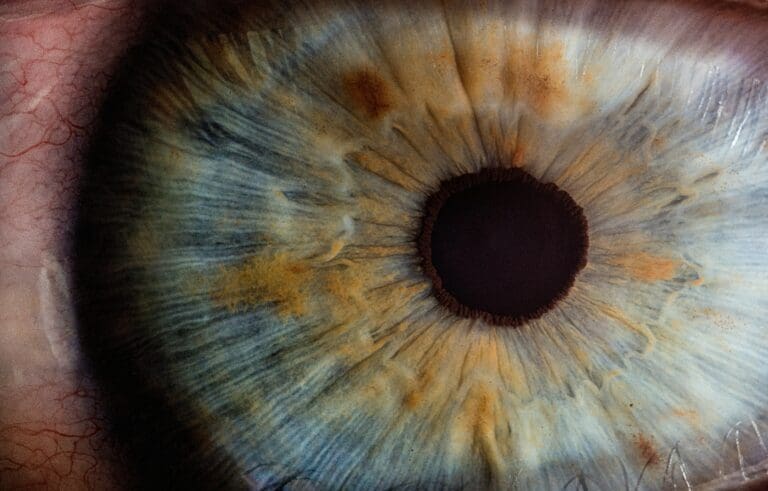
VISION3D
Uses holographic volumetric 3D printing to produce next-generation intraocular lenses, improving visual quality after cataract surgery.
Technological University Dublin
Lead: Dr Emma Branigan
Digital Infrastructure
Relieves congestion on hospital wireless networks by enabling direct device-to-device communication, removing access points as a bottleneck.

Hospital wireless networks are increasingly unable to support the growing demands of connected medical devices. Device densities now commonly exceed 10–15 devices per hospital bed and continue to rise, resulting in network congestion, coverage limitations and reduced reliability. These challenges will intensify with the adoption of the emerging Service-oriented Device Connectivity (SDC) standard, which requires continuous peer-to-peer communication between medical devices. Conventional Wi-Fi architectures route all traffic through central access points, unnecessarily increasing airtime usage, creating bottlenecks and introducing single points of failure.
PRISM addresses this challenge through a novel wireless communication module that connects to existing medical devices via standard Ethernet and automatically forms a resilient wireless mesh network without requiring new hospital infrastructure. The mesh extends coverage through multi-hop communication while enabling true peer-to-peer transport of SDC traffic, avoiding inefficient access-point relaying. By integrating cellular and wired Ethernet as complementary backhaul options, PRISM improves network resilience and ensures uninterrupted connectivity. Its innovative dual-radio architecture exploits approximately 88 orthogonal channels across the 2.4, 5 and 6 GHz spectrum, delivering substantially greater capacity, spectral efficiency and support for high-density medical device deployments.
PRISM is positioned to address the rapidly growing US$17.6 billion medical connectivity market through a B2B business model focused on medical device manufacturers. Market demand and the value proposition have been validated through direct engagement with leading industry partners, including Letters of Support from Becton Dickinson and Boston Scientific, alongside collaborative discussions with Medtronic, Siemens Healthineers and B. Braun. By enabling scalable, reliable and infrastructure-independent medical device connectivity, PRISM has the potential to become a foundational communications platform for the next generation of connected healthcare systems.
Last updated: 25 September 2026
Uses holographic volumetric 3D printing to produce next-generation intraocular lenses, improving visual quality after cataract surgery.
Technological University Dublin
Lead: Dr Emma Branigan
Digital Infrastructure
Protects UAV communications from jamming by fusing spectrum measurements, RF fingerprinting and terrain data to reroute flights in real time.
Tyndall National Institute
Lead: Boris Galkin
Digital Infrastructure
An AI pedagogical engine for language education that embeds task-based teaching and CEFR-aligned progression, not just AI-generated content.
University College Dublin
Lead: Prof. Alessandro Benati
Digital InfrastructureLet's discuss how The ARC Hub for ICT can help accelerate your digital transformation initiatives and bring your innovative ideas to life.